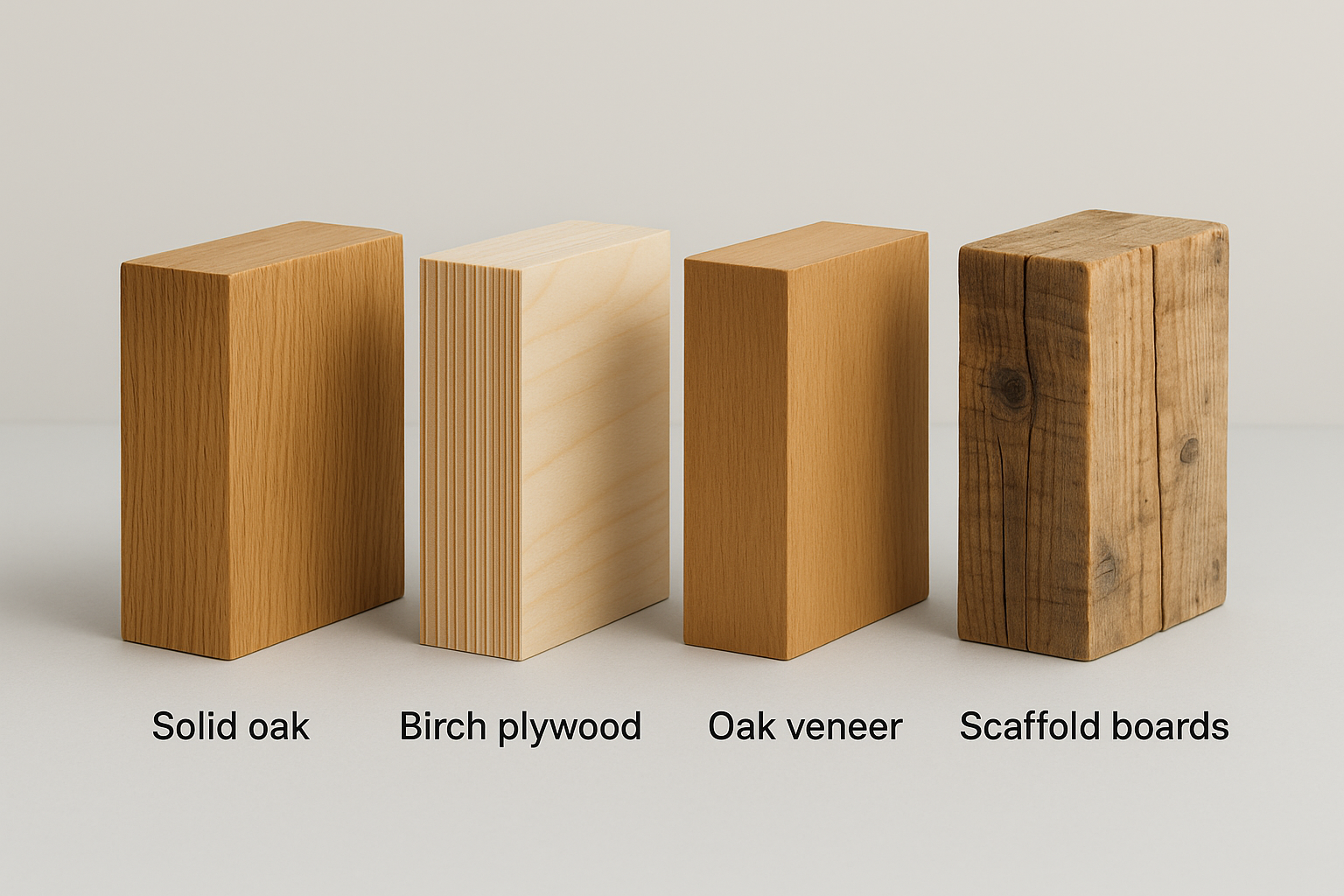
When you’re building your own desk, the top is the most important decision you’ll make. The legs provide support, but it’s the surface you’ll spend hours working on, writing, or using a computer. Popular choices for DIY desk projects include birch plywood, solid oak, oak veneer, and scaffold boards. Each offers its own character, performance, and price point. The right choice depends on your budget, the look you want, and how you’ll use the desk day to day.
The Style of Each Desk Top
Solid oak brings timeless character and luxury. Its deep grain and natural warmth make it an excellent choice for home offices, studios, or workspaces where you want a professional yet inviting atmosphere. It looks substantial and makes a strong design statement.
Oak veneer offers the look of oak in a lighter, more affordable package. Its smooth, consistent appearance works well in modern or Scandinavian-style interiors where clean lines are valued. Veneer is a practical option for creating a stylish desk without the cost of hardwood.
Birch plywood has become a favourite for contemporary furniture. Its pale colour, subtle grain, and layered edges give it a clean, architectural feel. It’s particularly suited to minimal or modern workspaces where simplicity and design-led aesthetics are key.
Scaffold boards provide rustic charm and character. They are chunky, full of history if reclaimed, and create a desk with an industrial or farmhouse appeal. This option works well in creative studios, loft apartments, or eclectic interiors where imperfections add personality.
Strength, Weight, and Practicality
Solid oak is very strong but also heavy. A desk made from oak feels substantial, but moving it can be challenging, and longer spans may need reinforcement. Oak stands up well to heavy use and can handle the weight of monitors, books, or office equipment with ease.
Oak veneer is lighter and easier to manage. Because it’s bonded to a stable core like MDF, it resists warping and movement. However, it’s not as robust as solid wood, and the thin surface layer limits how much wear it can take.
Birch plywood strikes a balance. It’s lighter than oak but still strong thanks to its multiple veneer layers. Large sheets are easy to cut into a desktop, and its stability makes it less prone to warping than solid wood. It does, however, need reinforcement for longer spans to prevent sagging.
Scaffold boards are thick and sturdy, so they naturally resist sagging, but they’re softer than oak. They can dent more easily, though for many people this simply adds to their rustic character. Because they’re individual planks, they also need to be joined to create a smooth desktop.
Durability and Daily Use
Desks experience a different kind of wear compared to dining tables — scratches from pens, dents from coffee mugs, and constant contact with hands and arms.
Solid oak is the most durable choice. It can be sanded and refinished multiple times, so even after years of heavy use it can be restored to look new again.
Oak veneer won’t last as long under daily wear. The thin veneer layer can scratch or chip, and once damaged, it’s hard to repair. With careful use and the regular use of coasters or desk mats, veneer can still serve well, but it requires more care.
Birch plywood is durable but not indestructible. Its top veneer layer is thin, so sanding must be done lightly to avoid going through to the glue lines. With a good finish, however, it can handle everyday use and still look attractive.
Scaffold boards are softer, so they will pick up dents and scratches more easily. For some, this adds charm; for others, it may feel messy. They are best suited to rustic or creative workspaces where imperfections are embraced.
Cost and Availability
Solid oak is the most expensive option. As a premium hardwood, it comes with a higher price tag, but it’s an investment in beauty and longevity.
Oak veneer is far more affordable. It gives you the look of oak without the same expense, and veneered panels are widely available, often cut to size for convenience.
Birch plywood is priced between veneer and solid oak. It’s more expensive than softwood ply but still cheaper than oak. It’s widely available from timber suppliers and is increasingly popular for furniture.
Scaffold boards are the cheapest choice. New boards are inexpensive, while reclaimed boards are even cheaper and come with added character. They’re easy to source from builders’ merchants or salvage yards.
Cutting and Preparation
Solid oak requires good tools and patience to cut accurately. It’s dense and heavy, so safety equipment and dust extraction are essential.
Oak veneer needs delicate handling. A fine-tooth saw blade, masking tape, or scoring helps avoid chipping along the edges. Sanding must always be light.
Birch plywood cuts cleanly with the right tools, but accuracy matters. A track saw is the best option, and dust protection is important due to the fine particles it produces.
Scaffold boards are easy to cut with a circular or mitre saw, but they must be joined together to make a desktop. Sanding is essential to smooth out the rough surface.
Finishing Options
All four materials need a finish to protect them from daily desk use.
Solid oak looks great with hardwax oil, Danish oil, or polyurethane varnish, each enhancing the grain while protecting the surface.
Oak veneer should be finished carefully with thin coats of oil or varnish. Avoid heavy sanding between coats, as the veneer layer is thin.
Birch plywood responds well to hardwax oil, which enhances its pale tone while offering good protection. Polyurethane can also be used for durability.
Scaffold boards suit oils that highlight their rustic charm. Hardwax oil enhances their grain, while varnish provides more protection if you want a tougher finish.
Which One Should You Choose?
Choose solid oak if you want a premium desk that will last for decades, can be refinished many times, and makes a bold design statement.
Choose oak veneer if you want the look of oak at a lower cost and don’t mind taking extra care to protect it from scratches and spills.
Choose birch plywood if you want a modern, minimal desk with a light and airy feel, at a price point between veneer and solid oak.
Choose scaffold boards if you prefer rustic character and affordability, and don’t mind a surface that will pick up marks and dents over time.
Conclusion
Birch plywood, solid oak, oak veneer, and scaffold boards each bring something unique to a DIY desk project. Oak is timeless and durable, veneer is affordable and modern but less long-lasting, birch ply is clean and contemporary, and scaffold boards are rustic and budget-friendly.
Paired with the right legs — whether slim hairpin legs for lightness or bold box section frames for strength — each of these materials can be transformed into a desk that reflects your taste, your budget, and your workspace needs. The best choice depends on whether you want luxury, affordability, modern minimalism, or rustic charm. Whatever you choose, building your own desk gives you not just a piece of furniture, but a surface designed for the way you live and work.
