Making your own desk is one of those projects that combines practicality with creativity. You end up with a piece of furniture that is tailored to your space, feels satisfying to use every day, and shows off materials that look better than anything mass-produced. A popular choice for a modern DIY desk is to use hairpin legs with a solid oak top. This combination balances elegance with strength, creating a timeless piece that works in almost any home or office setting.
The Style of the Desk and Where It Belongs
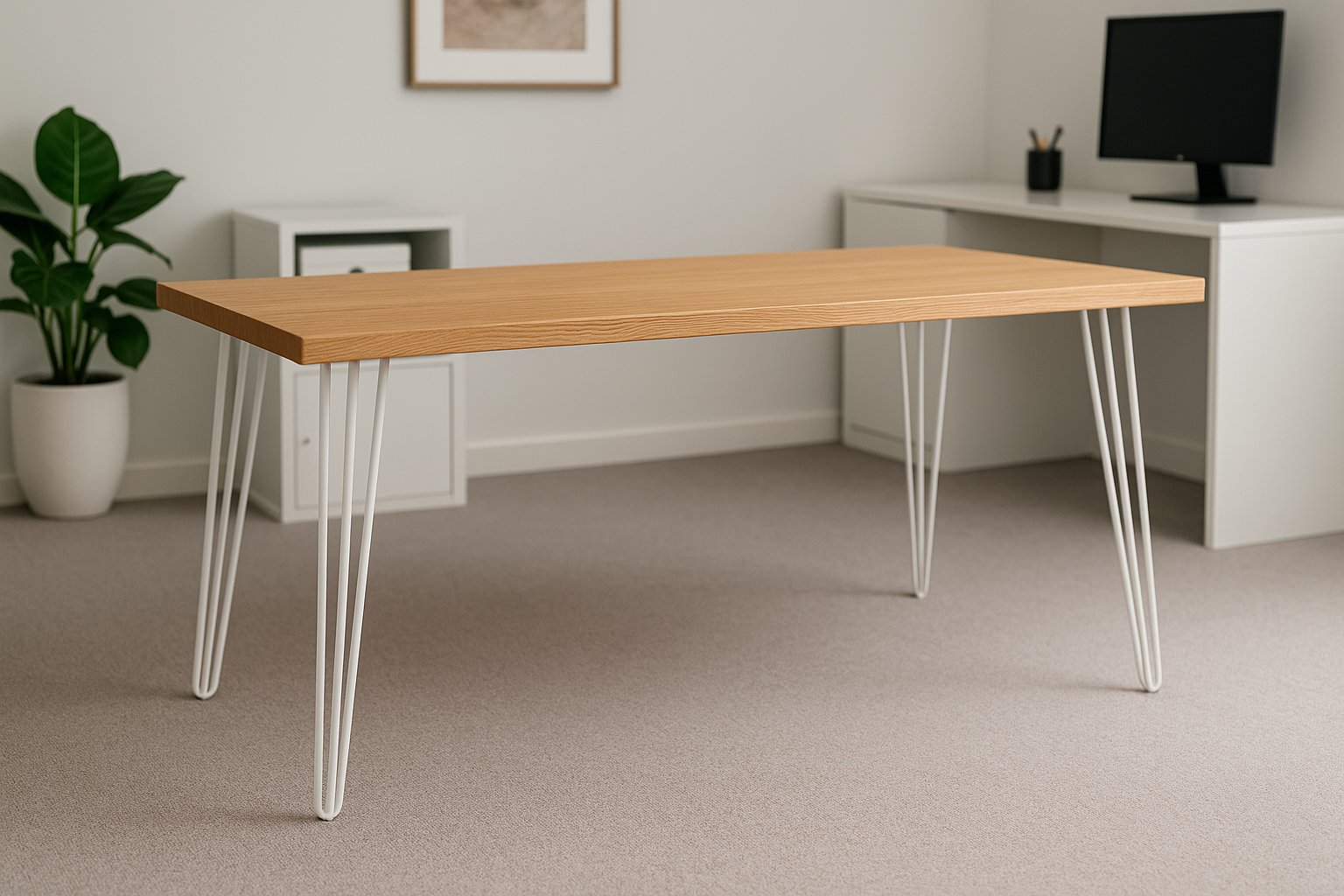
A desk made with hairpin legs and a solid oak top has a distinctive style that feels both contemporary and classic. The slimness of the steel legs contrasts with the natural depth and warmth of the oak. This creates a look that feels minimal but not cold, robust but not clunky. In terms of interiors, it suits a wide range: Scandinavian-inspired spaces with their preference for pale woods and simplicity, industrial-style apartments where metal features prominently, mid-century homes that nod to the era when hairpin legs were first invented, and modern family homes where a versatile desk needs to slot into a living room, bedroom, or dedicated office space without looking out of place.
What Hairpin Legs Are and Why They Work
Hairpin legs are made from steel rod that is bent into a U-shape and welded onto a mounting plate. Most designs use two rods, while some heavier-duty versions use three. The name comes from their resemblance to a bent hairpin, and despite their minimal form, they are strong enough to support heavy tops when properly attached. Their look is slim, unobtrusive, and a little industrial, which makes them a natural pairing for a wooden surface. They allow the wood itself to be the star of the show while providing the necessary strength and stability.
Why Hairpin Legs Combine Well with Solid Oak
Solid oak is one of the heaviest and most characterful timbers used in furniture making. Pairing it with bulky legs would risk making the desk feel too heavy and imposing. Hairpin legs are the perfect match because they balance out oak’s mass with lightness and simplicity. The contrast between industrial steel and natural wood is striking, while the strength of both materials ensures the desk is not only stylish but also durable. It’s a combination that brings warmth to modern interiors and refinement to more industrial settings.
Choosing the Right Colour for the Legs
Hairpin legs are typically available in black, white, or raw steel. Black is a safe choice that gives the desk a timeless and versatile look, while white feels lighter and works well in clean, modern, or Scandinavian spaces. Raw steel has an industrial appeal but usually requires sealing to prevent rust. If none of these quite fit, you can paint them yourself for a bespoke look. To do this properly, sand the steel lightly first so the paint adheres, then either brush or spray your chosen colour. Spraying generally produces the most even finish, while brushing allows for control in smaller indoor spaces. A clear protective topcoat can be added to extend the life of the paint.
Why Solid Oak Is Different from Cheaper Alternatives
Solid oak is a natural hardwood and has been used in furniture for centuries because of its durability, strength, and distinctive grain. Unlike laminated or veneered products, which have a thin decorative layer over a cheaper substrate, solid oak is consistent throughout. This means it can be sanded, refinished, and repaired over time, giving it a lifespan of decades rather than years. Laminates are cheaper but don’t have the same warmth, and once damaged, they can’t be restored. Veneered panels can look convincing at first but will quickly show their limitations if subjected to wear and tear. Solid oak, on the other hand, is an investment in both beauty and longevity.
Choosing the Thickness of the Oak
The thickness of the oak top plays a big role in both the appearance and the performance of the desk. Timber suppliers typically offer solid oak boards in 19mm, 24mm, 27mm, 30mm, and 40mm. The thicker the oak, the less prone it will be to sagging, and the more substantial it will feel. Nineteen millimetres looks sleek and is lighter to handle but may need reinforcement on longer spans. Twenty-four millimetres is often the best compromise between price, weight, and durability. Anything above thirty millimetres starts to feel very chunky, with forty millimetres being a bold statement but also extremely heavy. The choice depends on your aesthetic preference and how much strength you need for your setup.
The Realities of Using Oak
As a natural material, oak comes with certain features that you need to embrace. Knots are common and can either add character or be seen as imperfections, depending on your taste. Medullary rays, which appear as light streaks across the grain, are another distinctive feature of oak. Some suppliers offer “prime oak,” which has fewer knots and a more uniform appearance, while character oak embraces all of nature’s quirks. Either way, the wood will have variations, and that is part of its appeal.
Cutting the Oak to Size
If you are confident with tools, you can cut your oak top to size at home. A circular saw fitted with a fine-tooth blade will do the job, though a track saw will give the straightest and cleanest results. Always measure carefully, mark clearly, and cut slowly. Safety is essential when working with hardwood: use goggles, hearing protection, and a dust mask, and ideally hook your saw up to dust extraction, as oak produces a lot of fine dust.
If you don’t have the tools or the confidence, you can order oak tops already cut to size from many online suppliers. This saves the hassle of cutting, reduces wastage, and ensures square edges. It costs more per square metre, but for many people, the convenience and accuracy make it worthwhile.
Preventing Cupping and Sagging
One of the challenges with solid wood is that it moves with changes in humidity. Over time, oak can cup, meaning the edges curve upward or downward. To prevent this, you can add bars running across the grain on the underside of the desk. These can be made from wood and screwed in place, or from metal for a more engineered solution. The key is not to glue them, as the oak still needs to expand and contract naturally. For desks longer than around 150cm, it can also be helpful to add a lengthwise batten or “spine” underneath to prevent sagging in the middle.
Positioning the Hairpin Legs
When it comes to attaching the legs, position them about 5–8cm in from the corners. This creates a balanced look and ensures the desk feels stable. If the desk will be placed against a wall, make sure the legs don’t collide with skirting boards. Also think about legroom: placing the legs too far inward may interfere with a chair or knees. A quick mock-up with the legs held in place before drilling is always worthwhile.
Sanding the Oak
Sanding oak is straightforward but should be done carefully. An electric sander speeds up the process, starting with medium-grit sandpaper and working up to fine. Always sand with the grain to avoid scratches. If you prefer a more traditional approach, sanding by hand is perfectly valid and can be a meditative process, though it takes longer. The goal is to achieve a smooth, even surface ready for finishing.
Pilot Holes and Edge Profiles
Before screwing the legs into place, drill pilot holes. This prevents the oak from splitting and makes it easier to drive the screws cleanly. For a refined edge, you have the option of using a router to create a chamfer, round-over, or bevel, or simply easing the edges by hand with sandpaper. Even a slight rounding makes the desk more comfortable to use and gives it a finished appearance.
Finishing the Oak Top
A finish is essential for protecting the oak and enhancing its natural beauty. Hardwax oil is a popular choice because it is easy to apply, brings out the grain, and leaves a natural matte finish. Other oils such as Danish or tung oil penetrate deeply and give the wood a warm, rich tone, though they may need reapplying from time to time. Varnishes and polyurethanes create a tougher surface layer that resists spills and scratches but can sometimes look overly glossy. For the best result, apply several thin coats, sanding lightly between each one.
Conclusion
A desk built with hairpin legs and a solid oak top combines the best of both worlds: the strength and timeless character of oak with the elegance and lightness of steel. The result is a piece of furniture that is sturdy, stylish, and versatile. By carefully choosing the thickness of the oak, cutting accurately or ordering pre-cut, reinforcing against movement, sanding smoothly, and finishing thoughtfully, you can create a desk that looks professional and will last for many years.
This type of desk is not only practical but also a pleasure to look at and use. Whether you want it for a home office, a studio, or simply a stylish workspace in your living room, the combination of hairpin legs and solid oak offers a balance of tradition and modernity that few other designs can match.
